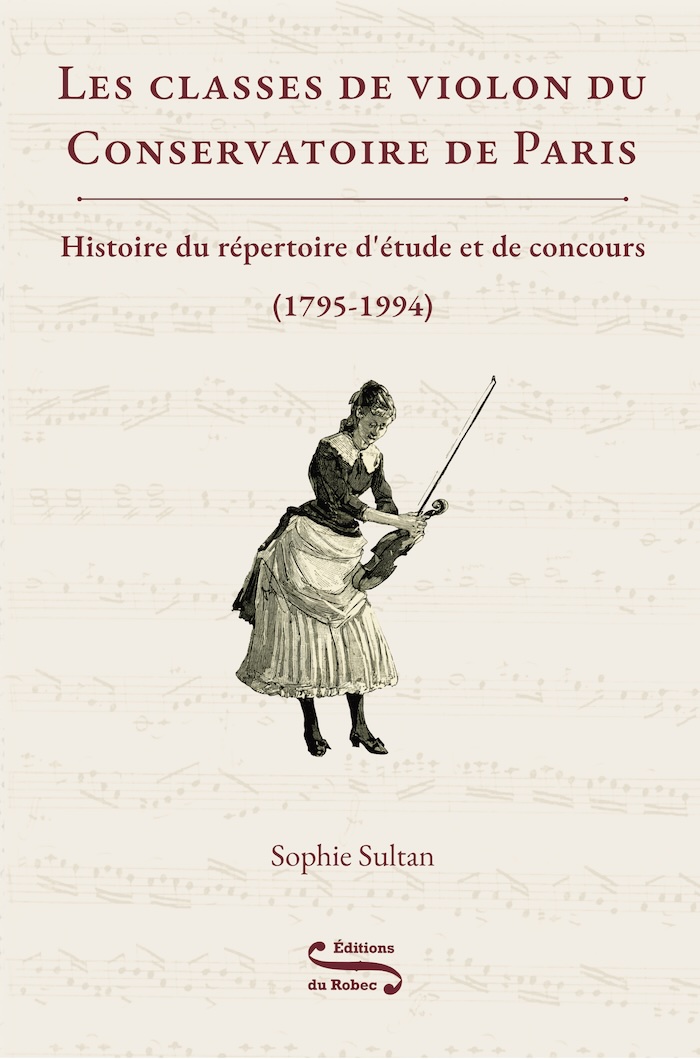
Les classes de violon du Conservatoire de Paris.
Histoire du répertoire d'étude et de concours (1795–1994)
A history of violin teaching and examination repertoire at the Paris Conservatoire.
Éditions du Robec (Rouen), 2026 · 488 pages
Format: Paperback (15,8 x 24 cm)
Language: French
ISBN 978-2-9564338-1-1
Summary
What do Henryk Wieniawski, Pablo de Sarasate, Fritz Kreisler, Jacques Thibaud, Ivry Gitlis, and Christian Ferras have in common? They all studied in the violin classes of the Paris Conservatoire (Conservatoire de Paris).
The law of 16 Thermidor, Year III (July 6, 1794), promulgated by the National Convention, marked the founding of the Paris Conservatoire. This new, republican school was expected to meet the high aspirations that had led to its creation and overcome many difficulties to maintain its existence. From the outset, leading musicians were invited to teach there, such as the violinists Rodolphe Kreutzer, Pierre Rode, and Pierre Baillot, leading figures of the “modern school”.
How is a violinist trained at the Conservatoire? What repertoire serves as the basis for their learning, and then for their evaluation? Is the Conservatoire open to new works? What are the keys to becoming a “Premier Prix du Conservatoire”, the Conservatoire's highest distinction? Who are the violin professors and what is their influence on the repertoire of study and graduation? These are the questions that gave rise to this book.
Through the study of previously unpublished archival documents, this work offers a precise account of what takes place within a violin class over a period of two centuries. The compilation and analysis of diverse sources (archives, press, concert programs, testimonies) allows us to appreciate, over the long term, the evolution of the curriculum and the expectations of the institution.
Four generations of violinists illustrate this journey into the heart of the violin classes at the Paris Conservatoire, through the accounts of Eugène Sauzay, Charles Dancla, Jules Boucherit, Jacques Thibaud, Ivry Gitlis, Devy Erlih, Régis Pasquier, and Olivier Charlier. QR codes to scan throughout the text invite the reader to complement the reading by ear. Finally, a rich collection of appendices is provided at the end of the book.
From the origins of the Conservatoire to the end of the 20th century, the book approaches violin teaching in this institution through the prism of repertoire. In doing so, it encourages reflection on the many ways instrumental pedagogy can be conceived.
Price: €45 (+ shipping)
France : fixed shipping rate
Other countries : please contact me for international orders
Shipping time : 2 business days
Back to Books.